
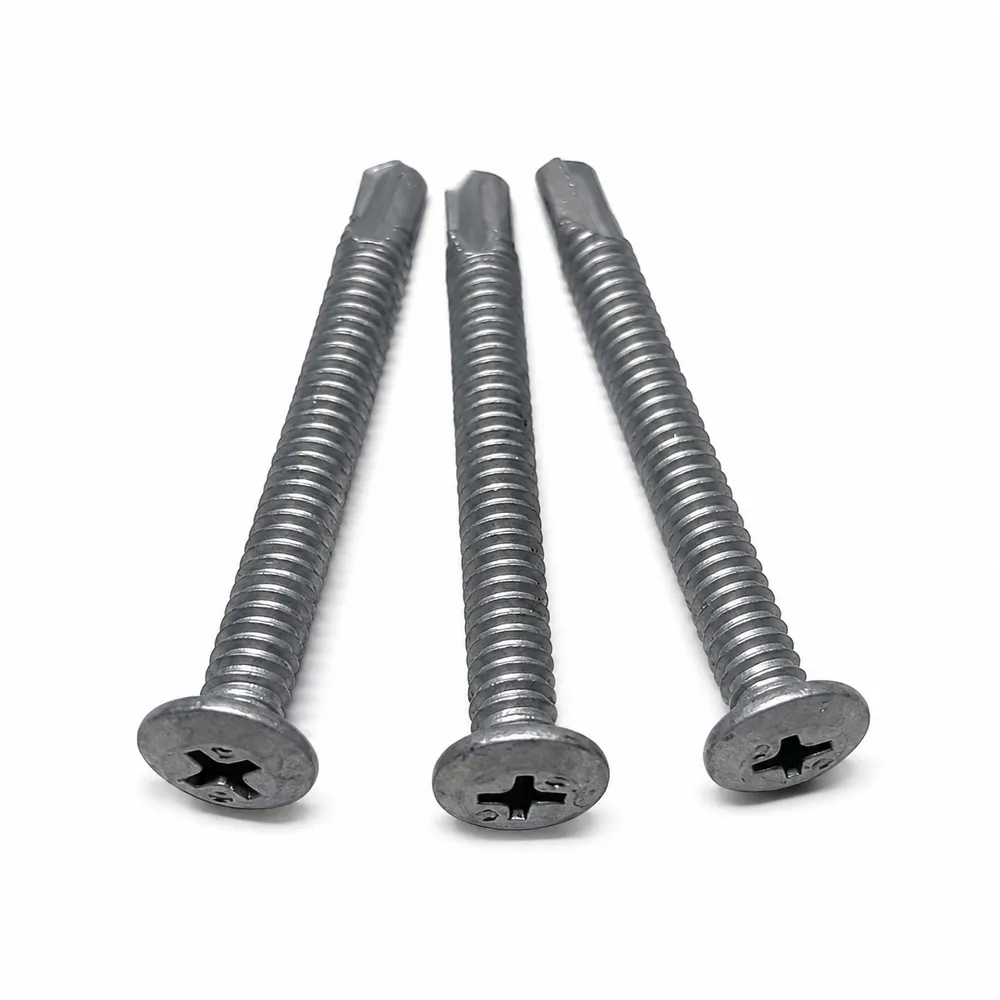
Length, head type and coating decide how well your steel-frame connection holds. Here is a short guide.
Choosing a screw for lightweight-steel framing is not only about length. Three things decide the result: head type, the thickness being joined, and the protective coating.
1. Match the head to the application
A wafer head is thin and wide — ideal for truss and batten joints because it does not lift the covering above it. A hex washer head is used on roofing and cladding: it can be driven with a socket and holds an EPDM washer. A countersunk head is used on fibre-cement board and GRC so the surface stays flush and ready for finishing.
2. Work out the joint thickness
A self-drilling point only works within a certain thickness range. For 0.75–1.00 mm lightweight-steel profiles, 10-24 × 25 mm is enough. Stacked joints or thicker C-channels are better served by 10-24 × 45 mm.
3. Pick the coating for the location
- Bright Zinc (BZ) — economical, ideal for interior and sheltered areas.
- Envirocoat — higher corrosion resistance for exposed, coastal or humid areas.
4. Test before a large order
Before committing to project volume, run a trial on the same material. Check whether the drill point bites without walking, whether the thread grips fully, and whether the head seats flush without damaging the coating.
Need help deciding? Our technical team can match the specification to your project.